Showing posts with label ramsey russell. Show all posts

7/05/2017

Argentina duck species

Duck hunting in Argentina is an epic shotgunning vacation, especially when hunting at the right place - not all Argentina duck hunts are created equal.  Relative to duck hunting in the U.S., bag limits are generous, and then there's the whole South American duck camp experience - steaks as thick as cinder blocks, malbec wines, Spanish accents, the works; the new hunting environment, sights and sounds.  But for our many clients, mostly it's all about the ducks; the rest just comes with the territory.

To some hunters, it's more about numbers, limits. Most hunters appreciate the diversity of new duck species in Argentina.  There are about a dozen duck species commonly encountered while duck hunting in Argentina. A few other species are less common.  Argentina is a very big country, too.  Some species are more abundant in some regions, and others have a fidelity to specific habitats.  Brazilian ducks and ringed-teal, for example, may be taken throughout Argentina but predominate the bag in some northern areas; black-headed ducks are usually going to screech over the decoys at Mach 3 when hunting sizable marshes with large patches of open water.

Everyone asks if we're hunting the same species as here in the States. No.  Some are very similar, do not migrate across the equator and have established separate breeding populations. An interesting thing about Argentina ducks is that many exhibit a continuous molt pattern.  Unlike here in North America, where our ducks molt twice annually, most look exactly the same throughout the year.  It's possible that this is because they have such extensive breeding seasons. In good, wet years, they've been known to have 2-3 clutches during the year.

Rosy-billed pochards are to Argentina duck hunting what mallards are to U.S. duck hunting. Large and gregarious, they decoy readily. If I had to choose a single duck to hunt outside the United States, it'd be the rosy-bills in Argentina, and nobody but nobody flat out OWNS them like our long-time outfitter at our most popular Argentina duck hunt Las Flores, but I digress. Rosybills do that to me.

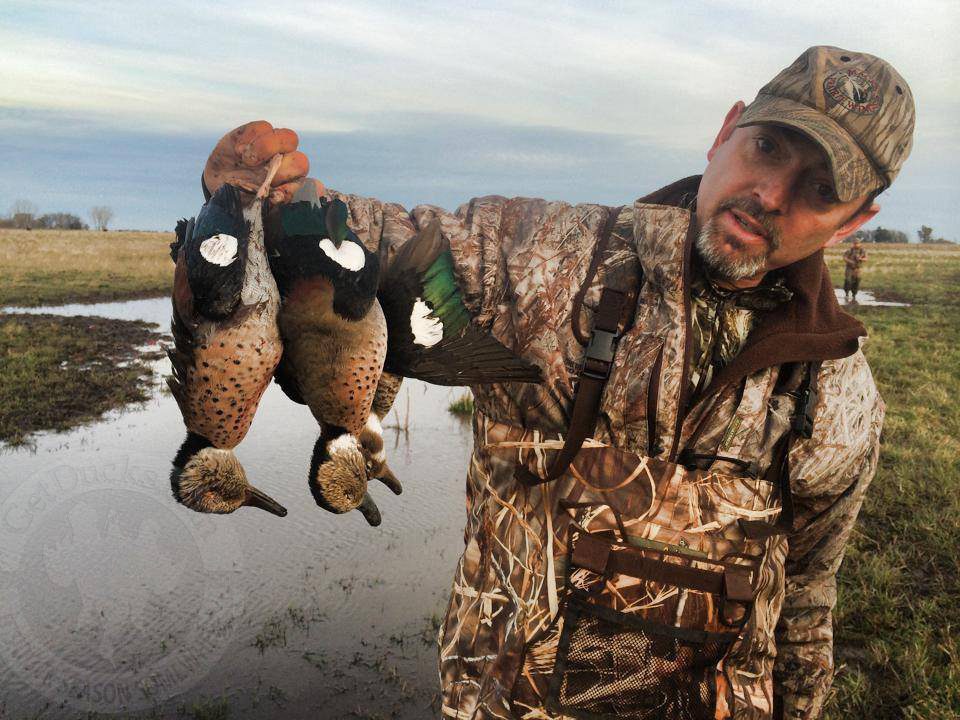
In addition to rosy-billed pochards, other common Argentina ducks include speckled teal, silver teal, cinnamon teal, ringed-teal, Brazilian duck, Chiloe wigeon, red shoveler, white-faced whistling duck, fulvous whistling duck, yellow-billed pintail and white-cheeked pintail.  Other far less common species include masked ducks, knob-billed ducks and even blue-winged teal. We've encountered all of the species during a single week hunting at our Rio Salado Argentina duck hunt destination.

For more information, we've posted video discussions here: Argentina Duck Species.


Ramsey Russell  is a certified  wildlife biologist.  He owns and operates GetDucks.com, a full-time, full-service agency specializing in world-wide trophy duck species and epic wingshooting adventures.  Exploring the world's wetlands for the best client duck hunting experiences is a life mission, but hunting in Mississippi with family and friends, he says, is top priority when home.  It’s always duck season somewhere.

5/10/2017

"The mallard of Argentina"


Argentina was love at first sight in 2001.  I've since nurtured that romance, visiting dozens of times for as long as 2 months while scouting for the next great destination, revisiting dependably excellent lodges we've represented for years. Argentina's duck species are an impressive collection of teals, pintails, wigeon, shoveler and more. First-time clients rightfully want to get their hands on each of the dozen or so species available, and at the right place at the right time that's easily enough accomplished.

But for many, the rosy-billed pochard steals the show. Especially from the old salts that have been to Argentina many times, the most commonly asked question about any particular Argentina duck hunting venue is, "When is the best rosy-bill shooting?"  Eventually, the novelty of new, colorful species wears off like the shine on a new nickel. What remains is the pure heartbeat of duck hunting.  Rosy-bills are large, fast, agile, abundant, delicious - and above all, they love to decoy. For those reasons, they're often called "the mallards of Argentina."

Ramsey Russell  is a certified  wildlife biologist.  He owns and operates GetDucks.com, a full-time, full-service agency specializing in world-wide trophy duck species and epic wingshooting adventures.  Exploring the world's wetlands for the best client duck hunting experiences is a life mission, but hunting in Mississippi with family and friends, he says, is top priority when home.  It’s always duck season somewhere.

5/08/2017

My favorite duck?

My favorite duck? Easy. The next one.

No bird collector, I've managed to scratch off over 100 species and subspecies of worldwide waterfowl.  The hunting experiences, the memories, are all that are personally collected.

In the US, September blue-wings are like a kryptonite. Maybe it's just a timing thing - Fall finally hanging in the air like Spanish moss on live oaks - but I hunt blue-winged teal every morning possible.  Watching many thousands of them come off one of Steve Bigger's roosts one morning near El Campo (see this link Texas duck hunting guides for info ), where they filled the entire morning sky as we set decoys, was truly one of the greatest spectacles I can recall from many worldwide events.  "Don't let his excitement fool you," my buddy Mike Morgan told Steve, "Ramsey likes them all like that."

Wood ducks streaking low over the decoys at the crack of dawn, swarms of green-wings hitting the pocket and springing upwards at the volley, sometimes-finicky gadwalls working through the cypress tops, tight knots of ring-necks tearing low over the blocks with afterburners blowing, elegant pintails, gleaming in the low sun while banking in formation, fattened greenheads backpedaling and buzzing after they've finally committed - all are shown the love with equal opportunity. And since there's always the inevitable mornings that eager trumps pretty, whoa be unto the lowly shovelers. Bless their hearts, there are parts of the world that they're also called Ramzillas.  

A strap of mallards is especially gratifying in my part of the world these days. The opportunity to bag mallards is never missed, no matter what else is on the radar or how far we've traveled to get there.  Mallard on 4 of the 6 continents visited, in 10 countries and counting, you can take the man out of Mississippi, but can't take Mississippi out of the man.


Ramsey Russell  is a certified  wildlife biologist.  He owns and operates GetDucks.com, a full-time, full-service agency specializing in world-wide trophy duck species and epic wingshooting adventures.  Exploring the world's wetlands for the best duck hunting experiences for his clients is a life mission, but hunting in Mississippi with family and friends, he says, is top priority.  It’s always duck season somewhere.


5/05/2017

Is Mexico's liberal pintail limits the reason we're shooting fewer pintail in the US?

Throughout the entire Lower 48 the bag limit for northern pintails will be reduced to 1 daily for the 2017-2018 season, but Mexico duck hunting will continue to entail far more generous pintail limits. Surely it's the over-shooting of pintails south of the border that's causing the pintail limits to be cut in half next year, right? While a number of disenfranchised internet experts seem to think so, this assumption is untrue.  

Consider this: fewer ducks are shot during an entire season in Mexico than in California or Louisiana, for examples, during a typical opening week.  Consider also that the limit on pintail in Alaska is 8 daily. In the Canadian provinces of Saskatchewan and Manitoba the limit is 4 daily.  Pintail populations have been struggling for decades, and equitable hunter-harvest is not the reason the continental population of pintail is slipping.  The thousands of northern pintails harvested throughout the North American continent, from Alaska to central Mexico, are a drop in the bucket compared to cumulative attrition represented by an increasingly inadequate amount of safe nesting habitat.

Pintails are short-grass prairie nesters. The principle culprit for the decline of pintail - and it has been scientifically documented for decades - is the conversions of it's nesting habitat to agriculture, and no-till farming practices are an ecological trap.  Pintail now nest in the preceding year's residual stubble. As the current year's crops are planted, their nests are destroyed, sometimes along with the hen. While surviving hens will often re-nest, they produce smaller clutches that yield slower survival rates. Additionally, the prairie pothole region's proliferation to agriculture makes predators more efficient at finding ducks. 

Per the following Wildlife Bulletin article (1999): "The steady conversion of grasslands to cultivation in the western Canadian PPR since the 1950s and 1970s has markedly reduced the extent of safe upland nesting habitat, thereby reducing pintail productivity to levels below the threshold needed to maintain populations. Grain stubble attracts large numbers of pintails to nest in the early spring, and cultivation destroys virtually all nests. Additionally, Greenwood et al. (1995) and Boyd (1985) showed how nest success of prairie ducks, even those that don’t nest in cropland, declined as the proportion of cropland increased in the land- scape because suitable nest sites in scattered grass- lands and planted cover were rare and predators more efficient. Most wetlands in the PPR have been impacted by agriculture (Boyd 1985,Turner et al. 1987), and more than 85% of the region has been cultivated (Millar 1989)." Source: https://www.werc.usgs.gov/fileHandler.ashx...


Ramsey Russell  is a certified  wildlife biologist.  He owns and operates GetDucks.com, a full-time, full-service agency specializing in world-wide trophy duck species and epic wingshooting adventures.  Exploring the world's wetlands for the best client duck hunting experiences is a life mission, but hunting in Mississippi with family and friends, he says, is top priority when home.  It’s always duck season somewhere.
4/10/2014

The Best Was Last

Mallards and pintail galore.  Within days of Mississippi duck season’s closure  there were lots of ducks at Willow Break.  Mississippi’s post-season Youth Day provided a solid crack at them.

Not that duck season was uneventful.  It was a great season – a record-setter for Willow Break – but weird.  In the year they started naming winter’s cold fronts, repeated clippers brought ducks but not the massive waves of ducks expected; not mallards and pintails.  Not this far south. It was the day after Christmas that I saw my first flock of shovelers, colloquially referred to as “Ramzillas” for good reason, or even the first sizeable flock of green-wings.   But where there's duck hunting, there's always hope.

4/03/2014

"Only a Mallard"


duck hunting trip
I get it: beauty is in the eye of the beholder.  But having grown up hunting in the Deep South and despite an exotic waterfowl species totaling about 100 huntable species world-wide, the splendor of decoying greenheads remains one of the most fundamental beauties in waterfowling - a heart-thumper every time. 
A couple of guests from the island-nation of Malta brought fresh perspective to things we might otherwise take for granted.  Malta, for those like me that can't place it on a map without googling, is a small island-nation situated in the middle of the Mediterranean Sea.  Twenty-one by 14 miles in size, its population is nearly a half-million.  Some of the oldest remains of human civilization, pre-dating Stone Henge, are there.  Through time it’s been occupied by nearly everyone in that part of the world.  Land, let alone hunting property, is scarce.  Barbeque ribs, southern baked beans, fried chicken and corn on the cob, I learned, are completely non-existent.  But I’ve never met more zealous wildfowlers, more competent hunters or better shots.

Hunters and bird collectors, GetDucks.com arranged their trip from the middle of the Mediterranean Sea to the middle of the Bering Sea to hunt King Eiders.  They’re the first from their country to have hunted them.  An invitation to join us in Mississippi was quickly accepted because it’s right here in Mississippi that their most-prized species would be hunted.

7/25/2013

Time flies in the duck blind

It now seems as long ago as my own childhood.  I started taking my sons hunting when they were practically babies.  Exposing them to hunting and camp life at an early enough age, I hoped, would moderate later distractions that seem inevitable in this technologically-addled and virtually-enabled world. 

There’s no wirelessly connecting youth to nature. They have to get their waders muddy in a swamp, get their hands bloody at a skinning rack, get their stomachs full around a camp dinner table.
Not just hunting but an entire experience:  mud wrestling while building duck blinds, catching snakes while spreading Japanese millet, netting crawdads while pulling boards from water control structures.  And always duck hunting.

7/18/2013

New Zealand duck hunt was far from home, yet close

New Zealand 17 hours into the future from New Orleans.  It's takes 14 hours in the air from San Francisco. That's plenty of time to get a full night's sleep and watch a half-dozen in-flight movies.

New Zealand is the size of California.  Comprised of two islands, the population is about 4 million people.  North Island is predominately pasture, to include livestock-beneficial and clover-chicory crops.  Sheep and gates that confine them are countless.   Forests cover remaining areas and are either lush stands of native species or highly-productive plantations of radiata pine, that are native to California's central coast.


New Zealand red stag huntingHunting in New Zealand is widely accepted, because of the country's mostly rural, farm-connected lifestyle.  The carefully cultivated habitat teems with trophy game animals originating elsewhere in the world: red deer, fallow deer, rusa deer, sambar, elk, white-tail deer; tahr and chamois.  As in the US, big game are the rock-stars of New Zealand hunting.

New Zealand duck hunting opportunities are plentiful, too.  There are native paradise shelducks ("parries"), Pacific black ducks ("gray ducks"), Australian shovelers ("spoonies") and self-introduced black swans.  Introduced mallards are proliferate in the absence of natural predators, to the increasing derision of native black ducks.  Canada geese are too.  Upland bird hunting species consists of native pukekkos ("blue pheasants"), introduced ring-necked pheasants, Gamble's quail, Merriam's wild turkeys and peafowl.

Without fox or coyote predation, turkeys are as likely to roost on a fence post, or in quail-like covies on the ground, as in a tree.  Paradise shelducks are keen to spend the entire night on the farmer's crops.  A remote, geographically-isolated island nation, there aren't waterfowl migrations in New Zealand; there isn't a push of new, dumb ducks and local ducks quickly learn the tricks of the trade.  Duck hunting customs reflect these differences.  There are the usual duck hunting accoutrements - decoys, calls, and oftentimes elaborate duck blinds ("maimais"), but there's also legalized baiting, unplugged firearms and shooting hours well past black dark. 

New Zealand duck hunting
While duck hunting in New Zealand is popular, many only hunt the opening day or weekend.  Then there are the true duck hunters, that like us, are in it until the end. Like that afternoon in a light, steady, bone-soaking rain.  We started off hunting the paradise shelducks. It was something to do until the main event that evening.  Capitalizing on the few parries that presented themselves over the decoys, we took no prisoners. Karl swore the borrowed 870 fit him poorly but then quintupled in an impressive feat that I witnessed from across the field.

Our farmer-host arrived at 5:15 pm.  We shooters then strung ourselves loosely down a sliver of spring-fed habitat he'd recently constructed.  With our backs against a high, wet-rock bank and a wind hitting our faces, we watched the landforms melt into blackness. The quickly-fading sky that continued to empty.  Abruptly from behind, a quartet of mallard arrived low, on whistling wings and chattering feverishly.  Fire blazed from gun barrel and the water's surface flashed like lightning, then rippled where fallen mallards had splashed.  In came another pair, then another. More: faint shadows against a nearly dark sky, more shooting.  It was over by 5:45.

New Zealand duck hunting
Afterwards, a young yellow lab, Willow, ferreted fallen ducks from the water.  Soaked from rain, we hunters visited in the glow of rain-infused headlight beams. Hand-shakes and introductions followed quickly by laughs about the hits and misses, by discussions of places and ducks hunted and of politics here, there and abroad.  A cheerful banter of Queen's and Southern-English, like we'd known each other for longer than the moments we shared a quick duck hunt in New Zealand.  It's one of those universal truths in duck hunting - only duck hunters stand around in the rain talking about duck hunting.  New Zealand was far from home, yet close.
 
Learn more: New Zealand Duck Hunting

View photo gallery: New Zealand Duck Hunt (North Island)

Ready to pull the trigger?  Ramsey Russell ‘s GetDucks.com is a full-time, full-service agency specializing in wing shooting with major emphasis on trophy duck species and duck hunting adventures. It's duck season somewhere. Your trip of a lifetime deserves – and receives – our full attention. 

7/11/2013

Argentina duck hunting these days - laughs are just seconds away

The other day, the outside thermometer could be seen plainly reading in the high-90s.  The heat index was 103.  Good old Mississippi summertime: growing tomatoes, mowing lawns, planning outside to-dos for mornings and late-afternoons.   Mid-day walks to the mailbox cause for breaking a sweat if you piddle.  So I was thankful to be working in the air condition with plenty to keep me busy.  Then the phone chirped with an incoming message from clients duck hunting in Argentina.

6/27/2013

Dream Duck Hunting Trip? Here's One

Favorite duck hunts may be spent in familiar haunts near home, with family and close friends.  Decoying mallards and gadwalls in cypress brakes, bouncing teal across flooded bean fields, and shooting passing woodies from oak-lined creeks are fun times we duck hunters live for.  Hunt-wise, opening day of Mississippi's dove season is the last on Earth I'd miss for anything.

Duck hunts is the stuff from which dreams are made, and dreams vary greatly among waterfowlers.  Unique species, simple changes in scenery or trigger-pulling that's been illegal in the U.S. for nearly a century are among the many reasons that seemingly normal duck hunters may travel.

Duck hunters are often described as crazy for playing in water during cold weather, but some duck hunters are crazier than others.  And it's a mighty big world.

I've got a bucket list of duck hunts around the world, too. Wild and remote places compel me.  Adventure is a must; new species are a plus.

duck hunting in argentina
One dream hunt presently exists solely in snapshots and the translated, first-hand description of an Argentine acquaintance's quest for his own dream duck.  The hunt occurs in a remote jungle – as wild as anything in the Amazon Basin much further to its north.  Hunters leave the hotel long before daylight, drive down tire-rutted trails into jungle blackness.  Temperatures are in the 90s.  Walk down hand-cut trails by headlights, towards coconut palm-studded swamps.  There are numerous duck species and liberal shooting limits.  The duck that draws you here feeds exclusively on young, walnut-sized coconuts. The swamp seethes with insects, with yellow anacondas as long most living rooms are wide.  Monkeys scream from the treetops at daylight, maybe a jaguar roars from deep within the forest shadows; you hear your intended quarry’s wing beats on mangroves, like fast raps n wooden doors, as they grow impatient to feed.  Later they will take flight, weaving through towering palms towards waiting decoys.

There's a crazy twist to it that is, as Paul Harvey would say, the rest of the story.  That will be continued later.

What’s your dream duck hunt?

Ramsey Russell ‘s GetDucks.com is a full-time, full-service agency specializing in wing shooting with major emphasis on trophy duck species and trophy duck hunting experiences. It's duck season somewhere. Your trip of a lifetime deserves – and receives – our full attention.  Ready to pull the trigger?

6/20/2013

Rio Salado Argentina Duck Hunting Way Off the Beaten Path

duck hunting in argentina
Right about the time you think you've seen and done it all, a really special duck hunt is found that reminds me of what I've really been hunting for in the first place. Getting there took some doing. 

Located in the northern Santa Fe Province, about 300 miles from Buenos Aires, the last 30 miles is regularly graded, non-graveled dirt road.  It had rained hard before our arrival so we crept at a snail's pace for the last hour.  With any idea of what lay ahead, I'd have walked it.

My heart was still beating hard from a quarter-mile walk to the blind, but in the somber, gray relief of a cloud-covered daybreak, I knew it immediately. For a decade, I'd visited duck holes world-wide to find it; it's where I want to be buried.

6/13/2013

Gould's Turkey Hunting Mexico's Sierra Madres: Trip Report

"Gould’s turkey hunting is one of those hunting trips of a lifetime you might do twice," explained client Chris Adkins of West Virginia.  Whether you’re a serious turkey hunter or not.

Hosting Gould’s turkey hunt in Durango, Mexico falls under my job description not hobby.  Besides, I'm a duck hunter at heart.  A few days Gould’s turkey hunting in the beautiful Sierra Madres with die-hard turkey hunters is nearly enough to make even an ardent duck hunter. like myself a turkey hunter.

6/06/2013

Uruguay Duck Hunt at New Tacuarí Lodge

duck hunting in uruguay
It's not as easy as it sounds.  Finding and delivering duck hunting trips around the world entails long hours, arduous travel away from home and the hassle and inconveniences that come with it.

I know, I know, but someone has to do it (and just wait, I've got a whole series of stories about things that happen along the way you'll never, ever read about in slick travel brochures).  I like traveling to new places and pulling the trigger, but new and different experiences, preferably way off the beaten path, are most compelling.

Most GetDucks.com wingshooting destinations offered in South America are as convenient to an airport as Disney World to Orlando.  The duck hunting is incredible; total-package experiences relative to duck hunting locally are unbelievable. Sometimes we get real lucky and find something harder to get to, but worth it.  Our new Tacuarí Lodge Uruguay duck hunting program is the perfect example.

The best duck hunting in Uruguay is located to the east.  Many duck species common to Uruguay are rare or not available throughout much of Argentina.  Uruguay duck hunts are usually operated from hotels and let's face it, who wants to travel that far to stay in a hotel?

Tacuarí Lodge is located 5.5 hours from Montevideo, in remote northeastern Uruguay, right across the river from Brazil.  We drove past other duck hunting operations getting there.  It was worth it.  What awaited surprised us.

5/20/2013

Eight of Clubs

At Willow Break, we draw blinds at 5:30 AM.  Sharp.  High card gets first pick.  There’s always a crowd of anxious duck hunters on Opening Day.  There’s always friendly handshakes and back slapping between gulps of warm coffee.  There’s never mention of duck reports or favorite spots. You’d think we’d not seen each other in months and were just having a friendly reunion.  It then gets quietly serious as the dog-eared deck is shuffled and members pull chances from the scattered pile.

Eight of Clubs didn’t win the big prize,  for damned sure.  It was poor consolation that I out-drew Ian, my long-time friend and former college professor, with whom the blind is traditionally shared on opening morning.

Our chosen spot consisted of flooded coffeweeds.  There’d been enough ducks in preceding weeks that my oldest son broke from deer hunting and joined us - me, Duncan and Ian - in the blind. I’ve tried to raise him better and morning deer hunting during duck season is hopefully just a phase he’ll outgrow.

Ducks took flight as we walked into the darkness.  A few quacked from the shadows as we tossed decoys.  The morning held promise.

There was heavy cloud cover and no wind.  Knowing there’d be no shadows to hide in later, we situated ourselves further back into the coffeweeds, where we kicked water when working ducks.
The first pair ripped into the decoys from out of nowhere and splashed paddles-up on the water by the boy’s steel fusillade.  Redheads!

Next up were 3 mallards and I got in on the action, too.  With little to no wind, the morning's ducks decoyed randomly from all directions.   It was no barrel-burner, but mallards, wood ducks, green-winged teal, and ringnecks trickled in most of the morning. The rain held off, too, mostly.

During a similar duck hunt several years previously, Ian overheard Forrest and Duncan discussing a big buck they’d seen.  He struck the deal that for his not sharing the buck’s location with anyone else in camp, they’d agree to say, “Nice shot, Mr. Ian” every time he killed a duck in their presence.  The deal backfired during the very next volley.  It’s more fun to say it after misses, which happens as often as not.  The 2012 Mississippi duck hunting season opener was no exception, and we all abided the tradition of saying it on several occasions.

Cooper’s inexperience may have cost us a few birds on the strap were it not for the more experienced Asia, Ian’s pup out of Delta.  She marked and then recovered them handily from dense cover. 

We’ve shot more ducks together, and we’ve certainly shot fewer, but it felt good again to be in knee-deep water, duck hunting in Mississippi.  It felt good to be among a long-time friend, with both sons, and with a new retriever that was showing promise. Duck season and all that comes with it - including the occasional Eight of Clubs - had finally arrived.

10/05/2012

Unique Uruguay Duck Hunting Recipe: Duck Pate

Like everyone else at duck camp, I used to always put on a few pounds during hunting season and spent the summer losing them.  Now "it's ducks season somewhere" and that is more the exception than the rule.

5/26/2012

Ramsey Russell's GetDucks.com Reviews Russia Duck Hunting

Russia duck hunting, russia bird hunting, russia capercaillie
Fumbling hurriedly through loose ammo that’d also been dumped into the coat pocket, the wooden duck call was retrieved just in time to blow 4 lousy notes that squelched due to dried cork.   It was enough.  The drake mallard’s head yanked as he hit the end of an invisible tie, he turned on a dime and locked onto a solitary, paintless decoy and descended cupped-and-committed until his feet were right above ice-rimmed creek water near.  He recoiled backasswards at the clap of a single shot and I could only chuckle at having traveled such inconceivably great distance to start the hunt with a ordinarily beautiful greenhead.  It was only the beginning.
Russia duck hunting offers one of the few spring waterfowl hunts remaining in the world and it coincides with hunting for Capercaillie and Black Grouse during their famous courtship rituals.  Until recently, nearly everything I knew about Russia derived from watching James Bond reruns.  The real thing was much better.
In addition to hunting 2 of the most coveted trophy grouse species in the world, duck hunting in Russia presents